Monthly Archives: July 2009

What’s Black and White and Lightly Carbonated?

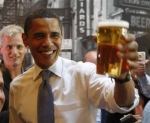
obama_beerYesterday’s “Beer Summit” adds a whole new dimension to the term personal diplomacy.  Actually, I thought Barack Obama, as usual, played it just right, telling the press “This is not a summit, guys.  This is three folks having a drink at the end of the day and hopefully giving people an opportunity to listen to each other.”  I’ll sip a beer anytime that it promotes and encourages social civility, dialogue, and cooler heads prevailing.

 The more I learn about that unfortunate front-porch incident and the background of Gates and Crowley, the more I’m convinced that they’re both decent, well-meaning men.  My guess is each copped an attitude with the other, tempers flared, and neither one was willing to back down and walk away when their encounter reached the flash-over point.  (Neither Cambridge cops nor Harvard professors are known to the world at large for their humility.) 

And in that case, it’s never, ever the police officer involved that ends up sitting in the backseat of the patrol car.  (Geeze, I think I was about seven-years old when I leaned that you don’t say anything to tick off a cop, on duty or off.  Isn’t that common sense?)

My one complaint about the Beer Summit, er, I mean, White House Happy Hour?

What’s Obama doing drinking Bud Light?

Mr. President, please, that is such a wimpy excuse for beer!  It’s training beer!  It’s water pretending to be beer when it grows up!  It’s the brewer’s equivalent of a typical politician’s stump speech:  focus-group tested, commoditized, homogenized, manufactured, and lacking any art,  depth, bite or satisfying, lingering aftertaste.  So unlike you!

I would have imagined that a man of your manifest sophistication and erudition—the best public speaker to have inhabited the White House in decades—would have rewarded your gold-plated throat and vocal cords with something better: maybe a hoppy, thirst-quenching IPA (I’m become very partial to that produced under the Long Hammer brand), or considering the summertime heat of the capital, a refreshing, cool hefenweizen. (Check out Harpoon’s UFO brew: Wunderbar!)

Then again, considering the barrage of polical flak directed at Obama a few months back from various right-wing cable talkers and other untethered nut-jobs for simply ordering a burger with dijon mustard, perhaps the astute maneuver was to stay away from elitist micro-breweries or foreign brands and stick with something middle-of-the-road and tasteless, but politically palatable.

I can almost hear Rush Limbaugh:  “In yet another sign betraying his true ultra-left leanings, Barack Obama drank a bottle of Stella—a beer produced in Belgium under a European-style, socialist regime that does not believe in giving their citizens the chance to choose their own personal physician—at yesterday’s Beer Summit.  Meanwhile, hundreds of patriotic American brewery workers are in danger of losing their jobs to foreign competition…..

I think I need a beer.

Leave a comment

Filed under Uncategorized

Facebook is Creeping Me Out, A Little

There’s something about Facebook that I can’t figure out.  Maybe you can help. scared

Background: I’ve been on FB for about a year or so.  I’m a pretty selective user, that is I don’t “friend” everybody and anybody that I might have shared a cup of coffee with since I was six-years old—the type of user I call a “Facebook slut” who promiscuously  links to hundreds of others.  (Hey, if the shoe fits….)  I’m linked to about 50 or so people, mainly old friends from high school and college, and a few former professional colleagues.

Recently, however, Facebook has suggested that I “friend”—I’ll never get used to using that as a verb—some people who are new acquaintances.  And what’s puzzling me is that these are individuals who I’ve been introduced to in a strictly professional context, and there are no pre-existing social webs between us that I’m aware of.

My question: How does Facebook know that I know these people? 

Of course, at its techno-heart, social-networking websites such as Facebook and Linkedin are just extraordinarily powerful relational databases.  That’s how they can recognise and suggest other people that you might know.  If you’re a friend of John, and John is a friend of Mary, it’s a pretty short logical leap to suggest that you might be a friend of Mary’s, too.

Likewise, if I graduated from Kegger U. back in 1979 (the parties! You wouldn’t believe!), and you attended dear old K.U.  at the same time, there’s a good chance we might know each other. (Whether we can remember anything is a different question.)  All Facebook’s computers have to do is seek those similiarities and match us up.  It’s the same for jobs—look for people who toiled, say, at Superior Frostbite Technologies, Inc., at the same time and then suggest they link to each other.

But let’s look at these two new acquainteances that Facebook has proposed to me. We have no shared educational experiences, work histories, or social overlaps that I’m aware of: 

  • Person No 1 is a real-estate agent who lives 100 miles from me, in northwest Connecticut.  Late autumn, I contacted her to explore the possibility of purchasing a plot of land adjacent to a summer cabin I own there.  We have since spoken on the phone maybe a half-dozen times and exchanged  less than a dozen emails.  (Nothing ever came of my real estate bid, btw). In fact, I have never met this woman face-to-face and I’m unaware of any mutual friends or acquaintances.  She happens to have a rather unusual last name, however, and earlier this year, Facebook plucked her from the 3.5 million people who live in Connecticut and popped her name up on my screen.
  • Person No. 2 works at a non-profit organization in New York where I have been doing some pro bono work since April.  Since then, I’ve emailed him a couple of times week to let him know when I’ll coming into the office.  No other social/professional cross-over that I’m aware of.  Yet somehow Facebook has pulled him from its ranks of 200 million registered users as being “friend-worthy”.

 What flummoxes me is how the hell does Facebook know of my connection to these people?  

 I can think of three possible explanations:

  1. This is an ultimate case of six-degrees of separation and there are deep, hidden connections that I am unaware of but that Facebook’s all-powerful Brainiac-like digital cortex can easily discern.  (Why, your great-great uncle Albert is a dead ringer for the no-good ice man who ran away with my second-cousin, once-removed, Bertha, who later was lost on the  Carpathia in 1918.  Wait a minute!….)
     
  2. Pure chance.  Call this the Rick Blaine explanation: “Of all the gin joints, in all the towns, in all the world, she walks into mine.” Possible, but unlikely outside of Casablanca. 
     
  3. Somehow Facebook is reading my email, or has gained access to the address book located on my home iMac.

Explanation No. 3 is not impossible.  Indeed, a few months ago I downloaded a piece of third-party software that allowed me to download my friends’ Facebook profile pictures to my iMac address book and trusty Palm PDA. (Yeah, at my advance age I often forget what my friends look like.)  I was unaware of granting any license, however, to Facebook to record on its servers the contents of my personal contacts list and use it for it for FB purposes.

But that’s the only plausible explanation I can think of.  And if it’s true, I think it qualifies as a significant invasion of privacy. 

Does anybody out there have any other ideas?  I’d love to hear ‘em. 


Leave a comment

Filed under Uncategorized

Things I’ve Learned From The Great Recession

gd49Like too-many millions of other Americans, my family and I have experienced the financial crisis as something more real than merely a cascade of gloomy newspaper headlines. My job was eliminated last year a few days before Thanksgiving, and the months since have been a slow, disillusioning slog, hunting scarce jobs as the economy wobbled and dipped, like a child’s gyroscope winding down.

Thankfully, my own sentence to downsized limbo now looks to be ending.  Here’s what I’ve learned during the last eight months:

  1.  If you have a job presently, make sure you back up important examples of your work—the stuff you’re proudest of—onto your personal flash drive frequently.  I can’t say this too much: back up, back up, back up!  These days, when the ax falls, it falls quickly and unmercifully, and you could find yourself forever locked out of your office computer and bounced to the pavement, without any chance to grab examples of the work you did for your now-former employer.  (This didn’t happen to me, but to my former boss.  It wasn’t pretty.)
     
  2. If you get the chop, it’s okay to be upset, but be civil and professional toward the HR apparatchik who delivers the bad news. It’s not personal.  As Tessio says in The Godfather, “Tell Mike it was only business, I always liked him.”  Staying on HR’s good side is important: They’ll be much more likely to grant you small favors while you negotiate your severance if you don’t act like a jerk.
     
  3.  As soon as you hit the street, get some new business cards reflecting your new independent-contractor status.  Nothing expensive or fancy, just something to remind people how to reach you. Check out Vistaprint.com.
     
  4. Don’t bother applying for any job advertised on Craigslist.  Your chance of getting a response from a prospective employer is considerably less than the odds of spotting Pope Benedict XVI getting the special lap dance at Scores on Easter Sunday.  Don’t waste your time.
     
  5. Likewise, ignore premium job sites like TheLadders.com that require you to pay up-front  to see their listings, as well as services that offer to shoot your resume out to hundreds of headhunters for a fee.   Zero results: Not worth it.  Husband your cash. 
     
  6. The Web is fueling a race to the bottom when it comes to freelance fees.  One Utah-based outfit contacted me about writing Websites for small businesses.  The pay: $.03 per word.  That’s right: three pennies! (I declined their munificent offer.)
     
  7. If you’re a finalist for a job and you don’t grab the brass ring, be gracious, positive, and thank the hiring manager for the opportunity.  Express interest in any future positions that might open up, and then stay in touch.  If their first choice doesn’t work out, they might come back to you quickly without restarting the interview process.  This actually happened to me.
     
  8. It’s true: Wine will get you through times of no job, better than a job will get you through times of no wine.  ‘Nuff said.
     

Leave a comment

Filed under Uncategorized

Do Not Fold, Kindle, or Mutilate

Even if they are, he'll do okay

But do you trust him?

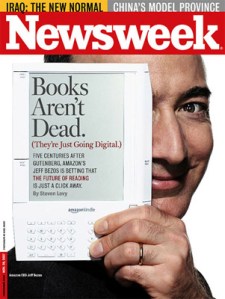
There’s an interesting summation in The New York Times today of the brouhaha over Amazon.com’s ill-advised kindlelostomy. (Sorry, couldn’t resist.)  I won’t replay the whole megillah here, only to say that it seems that Amazon.com decided it possessed the rights to sell the e-book of George Orwell’s 1984 (one of my favorite novels, by the way); then decided it didn’t; and to make everything all better somebody at Amazon decided that the smartest thing to do would be to unilaterally and remotely erase all of the offending, illicit 1984 copies from the Kindles of everyone who had shelled out $9.99 for one.

Jeff Bezos has already apologized to the wronged Kindleteers and admitted that Amazon’s solution was “stupid.”  But the episode highlights ones one of the defining characteristics of digital content (how I hate that word, but we’ll let that pass for now).

Old Media, whatever its flaws and drawbacks, is immutable.  When you buy a dead-trees book, newspaper, magazine or even a (dead-plastic?) DVD, you get to keep it.  It’s yours.  Forever.  The yellowed, much-thumbed paperback of 1984 that lingers on my bookshelf will always read, line by line, exactly the same way. (As a fan of all things Orwell, I say thank God for that.)  Short of breaking into my home, no miscreant can take it away.  That’s why it’s called a hard copy.

Digital media, on the other hand, not so much.  It’s much more than soft—it’s as stretchable, twistable, and mutable as Silly Putty.  That’s a great part of its appeal. Nothing is set in stone.  In fact, there’s no stone.

I can confidently predict that we’ll see more episodes like Kindlegate in the future, whether at the hands of big e-tailers needing to move more inventory, or rogue hackers looking to cause a bit of mischief, Digital Rights Management or no.  For if we’ve learned anything since the dawn of the Internet Era it is that any digital device can be—and eventually will be—hacked by someone determined enough to do so.

As publishers migrate to e-books exclusively, what’s to prevent some ticked-off hacker from erasing entire libraries, whether personal or institutional, with a few deft clicks of his mouse?  Just to prove they can.  Or a digital publisher from forcing the owners of a certain e-book to replace their old, worn copies with a newer, authorized version of the same title?  (Not so outlandish a scenario, if you’ve been following Scribner’s decision to reissue Hemingway’s A Moveable Feast in a new edition that portrays Papa’s second wife more sympathetically.)

Other, more sinister possibilities loom.  What’s to stop some interested party from hacking in to an e-book so as to change the work’s ultimate meaning and significance altogether?  This is not as far-fetched as it first sounds:  Entries in open-source encyclopedias like Wikipedia are frequently edited and redacted by those sharpening their personal ideological hatchets to reflect the facts as they see them.

Might someone tweak Uncle Tom’s Cabin just enough to portray slavery as a beneficent-but-misunderstood institution?  And Simon Legree as a struggling, well-intended entrepreneur, desperate to provide needed jobs to his beloved community, but forced to contend with unreasonable, unmanageable employees.

That would be the David Duke edition.

Or maybe make sufficient changes to 1984 to flip Orwell’s distopian satire of Stalinism on its back and transform it into a parable emphasizing the need for a resolute, unflinching, do-whatever-it-takes chief executive to rule a country at war.

That would the Dick Cheney edition, soon to be sold from an undisclosed location.

Update 6/6/2012: In the couple of years since I wrote this piece, I’ve wondered whether I was being over-the-top in my fears that  publishers wouldn’t be able to resist monkeying with digital books to suit their own ends.   Today I read that a new digital edition of “War and Peace” available for Barnes and Noble’s e-reader substitutes “Nook” for “kindle” (as in “to kindle a fire”) throughout the novel.  I wonder what Count Tolstoy would think.

1 Comment

Filed under Uncategorized

A Close Encounter With the WABM

A true story:  

 It is 1978.  I am 22 year old, standing on lower Sixth Avenue, under the marquee of the Waverly Theater, waiting for a friend.  It is July: the muggy air feels like a damp quilt hanging on my shoulders.  New York City is tense, still reeling from the recent financial crisis and the looting during the Great Black Out the summer before.  Black-white relations are bad and on everyone’s mind. 

 (Basically, all you really need to know is that Jimmy Carter is in the White House, and everybody believes things suck.) 

So, I’m standing on the street, minding my own business, wearing (if I recall correctly) the plaid sports jacket my father bought me when I went off to college.  I am truly a whiter shade of pale.  I hear him when he’s still a hundred yards distant:

 The World’s Angriest Black Man.

A block away, walking toward me on the sidewalk, is a black guy in his mid-20s, wearing a white dashiki, skullcap, and jeans. Not big, not tall, he is extremely wiry and muscled.  He has a wispy beard and feverish eyes and he is carrying on a high-decibel, furious monologue with a friend, gesticulating broadly.  I have never seen anyone so amped up in my life.

 “….So this motherfucker pulls a knife on me! And I tell him, ‘Asshole, whaddya think you’re doin’ wid that?”…

There are other people on the sidewalk and his effect on everyone is electrifying. Palpable tension shoots through the crowd as fast as a window pane cracks.

 “….So I pull out my own knife then, and I look that asshole in the eye, and I say to him, I gonna cut you first!..

It’s like a moment in a bad spaghetti-western, when the meanest, most ornery outlaw west of the Perdenales rides into town, and all the law-abiding, upstanding townspeople scurry to seek cover.

“….Then, I start chasing that motherfucker down street screaming,’ I’m gonna kill you!…

The World’s Angriest Black Man is striding closer.  I’m right in his path.  A horrible, heart-rendering collision is inevitable.  It’s like 60 seconds before the Titanic hits the fateful ice berg—except in this case the ice berg stands six-feet tall, weights barely 135 pounds, and hasn’t been in a fight since sixth grade.  And the Titanic could really, really use a Valium or two.

“….So he takes off and I take off and I’m running as fast as I can and I’m close to gettin’ him…

I try to stay cool.  I mean cool.  Hey, I say to myself, I know who Amiri Baraka is! I read The Autobiography of Malcolm X!  Twice!  I own a bunch of classic Miles Davis records!  I read Newsweek every week!

“….And then I take hold of my knife!…

The World’s Angriest Black Man is mere feet away.  He sees me.  I’m face-to-face with distilled nitro glycerin in human form.  One false move, and the WABM will go off on me.

“….And then can you believe what the mofo tries to do!…

Now the World’s Angriest Black Man is right in front of me.  Our eyes meet.  I can’t look away. And abruptly, like a shift in the wind, his voice changes.  It’s no longer the furious voice straight off Cathedral Parkway, but resonates of the Upper East Side.  

“Actually,” he says to me in a placid, self-assured tone, “I’m really passive.”

Leave a comment

Filed under Uncategorized

More Truthiness From the Folks at Fox

logo_foxBizThe wonderful marketing wizards at New Corp. at are it again.

Have your heard the new slogan for the Fox Business Network?  Fighting For You!

Yeah, they’re fighting for us—me, you, all the little people, and  Joe the Plumber (especially Joe the Plumber)—every blessed minute of the day over there at the FBN 24-hour business-oriented cable news channel.  Suddenly, I feel safe and secure, just like I did sipping Ovaltine back in my grandmother’s kitchen.

 Thank you, Fox Business Network, for manning the barricades and putting up your dukes on my behalf!  I slept sounder last night than I have in years.

I have just one question: Whom, exactly, are you fighting?

A digression: While I’m no fan of Rupert Murdoch’s nominal politics (he’s not so much a fire-in-the-belly conservative as much as a money-in-the-bank opportunist), I’ve always harbored a guilty admiration for this audaciousness, his ability to pivot on a farthing, and lack of any core principles.  (Some of you may recall that some years back this champion of freedom caved in to Beijing’s demands that the remove the BBC international service from his Star TV beamed into China.) 

And then there’s that “We Report, You Decide” mind-wash blared endlessly by Murdoch’s flagship Fox News Channel, which, in its sheer ridiculousness and total, utterly straight-faced disregard for what we call on my planet “reality,” should be chiseled on the façade of 1984’s Ministry of Truth.  It’s a perfect example of the Big Lie:  Repeat something often enough, loud enough, for long enough, and a certain percentage of the population will believe you, even if monkeys don’t really fly out your butt.

But back to Fox Business Network, which, while I’ve been jotting this post for the past 20 minutes has not relaxed its meaty, sledge hammer-like fists even to quickly scratch its nose, because it’s perpetually on guard, bouncing on its toes, getting off a few good jabs when it sees an opening—There’s a left! And a right! And another left!—and fighting for you and me!

I ask again, just whom is it fighting?  General Electric?  General Motors?  Con-Agra?  Microsoft?  The U.S. Treasury?  The Dow Jones Industrial Average? Or, maybe, the entire S&P 500? (Is that a fair fight, I mean, really?)  Is Murdoch, one of our era’s most successful practitioners of ravenous, gloves-off capitalism really turning on his fellow corporate titans?

Or maybe it’s a clever (?) attempt by Murdoch’s marketing lieutenants to tap into and ally Fox with the resurgent sense of populism and demands for a more equitable democracy that seems to be gathering steam (I hope) under Obama. 

 Sorry, America, for doing so much to foist that phony Iraqi war off on you a few years back, but now we’ve seen the light. And we’re fighting for you!

Trying to suss out what this marketing bilge is supposed to mean makes my middle-aged teeth ache and my gums bleed.  I’ll tell you what:

I’ll report and you decide.

1 Comment

Filed under Uncategorized

The Revolution Will Be Digitized

neda-soltanAm I the only one in the world with web access who has not watched Neda Agha-Soltan die?

Her death on a Teheran street—graphically, unflinchingly captured on a cell-phone camera—came during the protests that rocked Iran in mid-June after the clumsily fixed elections that cemented the regime’s grip on power.  The roughly 30-second video ricocheted around the web in the days following her shooting, endlessly rewound and replayed, Zapruder-like, until it became the defining, iconic image of the country’s civil unrest and thwarted democracy.

 I have refused to watch it.

I first read an account of what will probably go down in history as the “Neda Video” on my friend Craig Stoltz’s blog.  Craig’s usually displays a pretty hard-boiled, cynical patina, accumulated from spending years in a newsroom.  But as he described his reaction to the video, and his inability to shake off the terrible, stomach-churning spectacle of a young women bleeding out on the pavement, he was clearly rattled.

That was enough for me.  I resolved not to watch the video. Not to click on the link that would start it streaming. It seemed like the ultimate intrusion—both of a dying woman’s privacy, and my own.  And not too dissimilar from a snuff film.

Just to be clear: I abhor censorship.  And I don’t say the same thing about every image that graphically depicts death, such as Robert Capa’s famous image from the Spanish Civil War that captured a Republican soldier the fleeting instant he was shot.  Or from still-raw history, the photo of the so-called “Falling Man” suspended in mid-air as he tumbled from the World Trade Center on 9/11.

But those victims were unrecognizable, unnamed, and so still unknown.  The images were symbols of world-changing events.  They could not be linked to 24-year old students with family, friends, and MySpace accounts.

As digital cameras are built into ever-more devices such as cell phones and PDAs, it seems like every event, no matter how sacred or profane, will eventually be recorded and uploaded to the web, for everyone to see, gawk, and comment upon.  

And surfing the web has it’s own unique, irresistible momentum.  Like rhesus monkeys in some giant globe-girdling digital lab, we’ve all been trained by years of sitting in front a screen to keep perpetually clicking on the links displayed before us.  Taste, decency, privacy be damned. 

(I know, I know: I’m dating myself as antediluvian by mentioning these concepts.)

The seductiveness of the Web is that everything—everything!—is just a click away. The lure of the computer mouse can be just as silkily irresistible as the serpent in the Garden.

In those cases it might be good to ask: “WWUWD?” (What Would Uncle Walter Do?)

Sometimes the only decent thing is to look away.

2 Comments

Filed under Uncategorized

So Long, Uncle Walter

I wonder how Walter Cronkite would have responded to the tsunami of coverage and commentary sparked by his death last week at 92.  Certainly, his obituary earned its place above the fold on The New York Times. (To anyone under 40: That’s a newspaper term, referring to its placement on the top-half of the front page).  My guess is he would have expressed wry bemusement at the heaps of high-calorie, low-fiber pontificating and punditry his death inspired.  He always regarded himself as simply a reporter doing his job.

But make no mistake:  Presenting the news from the anchor’s chair on The CBS Evening News during two of the most combustibles decades in recent American history, Cronkite was a journalistic—and ultimately national—institution.

His privileged spot as one of the handful of men (yes, they were all men) heading up one of the three networks’ evening news shows made him a dinner guest (or after-dinner speaker, if you ate before 7 p.m.) in millions of homes, five nights a week.  In an era when Americans were hungry, desperate, for facts—about the confusing and unwinnable war in Vietnam; about the assassinations of the Kennedys and Martin Luther King, Jr.; or the U.S.-Soviet race to the moon—he supplied them in a sonorous, Midwestern baritone that so many people prefer their news (and late-night monologues) to be delivered in.

Yet, unlike today’s parachuting anchors, whose presence on the scene signifies an unfolding Big Story, Cronkite never portrayed himself as somehow bigger than the events he covered.

No one who has come of age since 1981, the year Cronkite retired and a few years before the networks commenced their slow, unrelenting slide into irrelevance, can truly comprehend the social sway that the Big Three network news anchors once wielded.  (Though as someone whose father and brother worked at NBC News for decades, I’d like to loyally point out that Cronkite only fully inherited the mantle of “Walter Cronkite” after The Huntley-Brinkley Report, the dominant news broadcast for most of the 1960s, went dark in 1970, when Chet Huntley retired.)

To a degree unimaginable today, the network anchors once set the national conversation. While Woodward and Bernstein became folk heros for uncovering Watergate in Washington Post, it was Cronkite, in his role as CBS Evening News managing editor, who decided to devote 14-minutes—an eternity-plus-a-day of time, in broadcasting terms, then as well as now—to explaining the scandal and its full implications to his TV audience.  Doing so, Cronkite boosted public awareness of Watergate to a new level and bestowed upon a flagging newspaper story new legs and significance.

Ditto for his 1968 broadcast that labelled the Vietnam War unwinnable, and urged Washington to negotiate with Hanoi and the Viet Cong.  Afterwards, Lyndon Johnson fretted to an aide, “If I’ve lost Cronkite, I’ve lost middle America.”

For the life of me I can’t imagine Barack Obama ever saying the same thing about Charlie Gibson, Brian Williams, or Katie Couric.

Update: This is interesting. It turns out the 1968 “Cronkite Moment” that I and so many others referred to might be an example of media’s self-mythification of its political influence, according to this post by an American University professor.

1 Comment

Filed under Uncategorized