
Monthly Archives: February 2010

Mogadishu on the Hudson

Few politicians have managed to waste the considerable political capital they inherited upon taking office as hastily as our profligate and erratic Gov. David Paterson, who was the beneficiary of so much good will when he suddenly took over from Client No. 9 only two years ago.  In that time, he’s gone from hero to zero.  And since the story broke of his latest mind-twisting political and legal blunder, I’ve been trying to think of an appropriate Third World nation to compare to the dysfunctional political culture and leadership afflicting those of us who still choose to reside in New York.

More and more these days, residents of New York feel powerless and disenfranchised, standing by helplessly as our political leaders pettily scheme against each other, line their own nests, and grandstand in the media—anything but effectively address the mounting fiscal problems that overhang the state  like Damocles’ sword.  Paterson’s self-inflicted travails have made great political theater, but they should deeply depress anyone who has a stake in New York’s future.
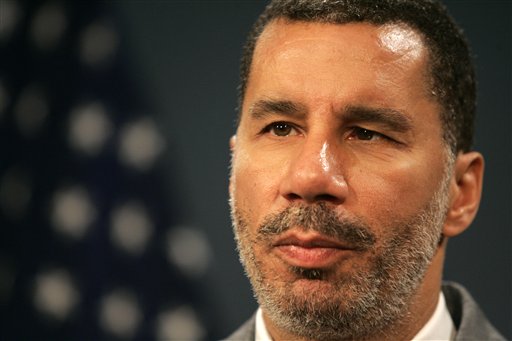
The Governor, for now

Increasingly, the once-glorious Empire State is beginning to resemble Somalia (No. 1 on the Fund for Peace’s Failed State Index).  A failed state, according to Wikipedia, is characterized by “[a] central government is so weak or ineffective that it has little practical control over much of its territory; non-provision of public services; widespread corruption and criminality … [and] sharp economic decline.”

As a New York resident since 1989, all I can say is that certainly sounds familiar.

This would make Albany the equivalent of Mogadishu. The only significant difference being that there’s probably more exciting things to do on a Friday night in Mogadishu.

Update 3/2/2010: The stench surrounding Paterson grows worse, as The Times reported Tuesday that the governor personally ordered two of his aides to contact the woman allegedly physically abused by his top aide. A political deathwatch has commenced: Top Democratic Party officials are said to traveling to Albany to meet with Paterson and discuss his options, as calls for his resignation grow.

If the New York were to lose its second governor  in only two years, it would be a horrific blow to the state’s image and future.  Me, I take absolutely no joy in any of this.  And while I’m usually among the last people to believe anything I read in The New York Post, a recent insider account of Paterson’s behavior in office—admittedly based on interviews with anonymous former aides—has the whiff of truth.  The most damning material was buried at the end, depicting a politician without any understanding of  the political process:

During talks about industrial-development policy, the governor slipped an overhaul proposal to some labor groups — then went to business big shots and loudly bashed all the suggestions that had come from his own office, said a source involved with the process.

“He was trying to determine what was his political advantage at any given moment,” the source said.

Paterson’s zaniness torpedoed a high-profile bill extending unemployment insurance last summer, sources said. After intense talks with labor and business leaders, the governor hammered out legislation both sides could live with.

“Then he sent out his own program bill without discussing it with anyone — and of course it was acceptable to no one,” said a lobbyist. “It just shows a complete lack of understanding of how the process works.”

That would certainly explain some otherwise inexplicable gubernatorial episodes, such as his mercurial, ill-treatment of Caroline Kennedy’s senatorial ambitions.

I hazard the guess that Eliot Spitzer is sleeping very soundly these nights.

Update 3/3/2010: It’s getting worse and worse, as the slow drip of revelations about gubernatorial misconduct now looks like it’s becoming a stream.  Anybody care to lay even money that David Paterson will still be in the Governor’s Mansion come May 1? While that would have been unthinkable a few days ago, it’s not so much today.


Leave a comment

Filed under Uncategorized

Caveating the Late Alexander Haig

Most of the obituaries of fractious former Secretary of State Alexander Haig focused on his white-knuckled appearance at the White Hose podium on March 30, 1981, when in the uncertain, fearful hours immediately after the attempted assassination of Ronald Reagan, he tried to reassure a shaken public  that  “I am in control here, in the White House.”  Anyone old enough to recall the events of that bizarre day will tell you that Haig’s jittery appearance was about as convincing and reassuring as Tiger Wood’s recent mediacentric mea culpa over his Olympic-class priapism.

Haig (right) with former National Security Advisor Richard Allen, March 30, 1981

Rarely has public ambition been so naked or unappealing. Tim Weiner’s treatment of Haig’s life and career in The New York Times is worth reading, however, for its wonderful dissection of Haig’s bumptious, short-lived tenure as “the vicar of foreign policy” in Reagan’s first term, as well as his crucial service as Richard Nixon’s last White House chief of staff as the Watergate scandal finally, irrevocably unwound, leading to Nixon’s 1974 resignation.  As Nixon, besieged by reality, retreated into the comfort of the bottle, Haig emerged as the de facto president during the last, awesome, crisis-ridden year of that criminally inclined administration.

What tickled me, however, was Weiner’s description of Haig’s uniquely tenuous grip on English.  Long before Bush-speak, there was Haig-speak, which carried on an equally long-distance relationship with the mother tongue:

He had a unique way with words. In a 1981 “On Language” column, William Safire of The New York Times, a veteran of the Nixon White House, called it “haigravation.”

Nouns became verbs or adverbs: “I’ll have to caveat my response, Senator.” (Caveat is Latin for “let him beware.” In English, it means “warning.” In Mr. Haig’s lexicon, it meant to say something with a warning that it might or might not be so.)

Haigspeak could be subtle: “There are nuance-al differences between Henry Kissinger and me on that.” It could be dramatic: “Some sinister force” had erased one of Mr. Nixon’s subpoenaed Watergate tapes, creating an 18 1/2- minute gap. Sometimes it was an emblem of the never-ending battle between politics and the English language: “careful caution,” “epistemologically-wise,” “saddle myself with a statistical fence.”

Now it’s my turn to caveat something: When politicians start sounding like Prof. Irwin Corey on a bad day, it is usually intentional, because they are trying to cover their tracks and/or backsides. Weiner concludes:

But [Haig] could also speak with clarity and conviction about the presidents he served, and about his own role in government. Mr. Nixon would always be remembered for Watergate, he said, “because the event had such major historic consequences for the country: a fundamental discrediting of respect for the office; a new skepticism about politics in general, which every American feels….

He was brutally candid about his own run for office and his subsequent distaste for political life. “Not being a politician, I think I can say this: The life of a politician in America is sleaze,” he told the authors of “Nixon: An Oral History.”

“I didn’t realize it until I started to run for office,” he said. “But there is hardly a straight guy in the business. As Nixon always said to me — and he took great pride in it — ‘Al, I never took a dollar. I had somebody else do it.’

As Haig might have said, there’s absolutely nothing nuance-ly about that.

Leave a comment

Filed under Uncategorized

Of Scoops and Snacks

One of my goals for the coming year is to pay way less attention to what gets posted on Gawker.com. It’s as addictive as all those salty snacks—Doritos, Pringles, Cheetos  (D’oh, Cheetos!)—that nutritionist warn us against ingesting, but we do anyway.  It’s a guilty, unhealthy pleasure.  But every now and then I’ll read something there that’s eye opening, based on actual reporting.

Such is the case today. Check out Ryan Tate’s post The Culture of Fear Inflames the Financial Wires, which follows up his earlier account of the new performance metrics introduced into the Bloomberg newsroom.  The news service’s editorial employees are now being professionally evaluated—and financially rewarded—on how many Breaking News Points™ they to accumulate for each of the scoops and exclusives they break. Basically, the news service is handing out gold stars to reporters based upon a dubious, inhouse-developed metric.

Not surprisingly, many Bloomberg employees have learned to game the system and make themselves shine on paper. As Tate noted in his post Wednesday,  after the new metrics were introduced “reporters magically produced nearly three times as many scoops in one quarter of 2009 as they had in all of 2008.”

Today, Tate writes that Reuters has its own counterpart to Bloomberg’s  scoop-o-meter.  Known as Beats and Exclusives, it is being used this year for the first time  to evaluate journalists’ productivity.  And the impact internally has been about the same:

The abuse we’re told is rampant under the Reuters “Beats and Exclusives” system should only get worse now that money is involved. Our source:

The people who actually file [“Beats and Exclusives” notes] tend to shamelessly game the system by trying to get credit for non-news that no other outlet had or cared about or for “exclusive” executive interviews that broke zero ground. I can’t imagine what’s going to happen now, when jobs and pay are on the line. (Emphasis added).

This is what happens when you import inappropriate performance metrics from Wall Street or the factory floor into a newsroom. A few months ago, a member of Sam Zell’s team, which has deftly managed the Tribune Company into Chapter 11, even suggested judging individual newspaper reporter’s productivity based upon the sheer number of words they pounded out over the course of a quarter or year. So much for striving to write tight and bright copy.

Quality journalism requires the investment of substantial time and is labor intensive. Real scoops are usually the result of arduous leg work, developing new sources and painstakingly winning their trust, and confirming and corroborating what they say with independent authorities. And sometimes promising leads don’t pan out.  As the legendary, late newspaper editor Jim Bellows used to say, commentary is cheap, reporting is expensive.

On the other hand, performance-boosting schemes like those at Bloomberg and Reuters don’t produce more news, but rather more news flavor. Similarly, my favorite Cheetos (D’oh, Cheetos!) may contain no real cheese, but still manage to pack plenty of lip-smacking cheese flavor.

In either case, the end result is the same: empty calories, no fiber, and a slightly queasy feeling.

Leave a comment

Filed under Uncategorized

No Additional Comment Required

We will be living with the painful, malodorous, and inescapable consequences of the real estate crash for years to come, I  fear.  Still, there’s a modicum of justice left in the world, as this article published in The Wall Street Journal proves.  As the late, brilliant Anna Russell was wont to say in the course of explaining to audiences about the plot of The Ring Cycle, “I’m not making this up, you know.”

Leave a comment

Filed under Uncategorized