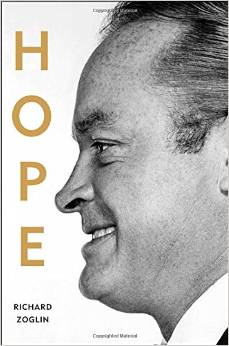
I don’t usually read celebrity biographies, but I made an exception for Richard Zoglin’s recently published life of Bob Hope, which attempts (successfully, I think) to restore some shine to the comedian’s star, which had dimmed considerably years before his death in 2001 at age 100.
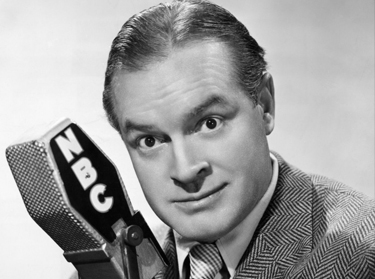
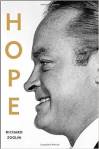 Zoglin makes a strong case for Hope as arguably the most important entertainer of 20th century America. Indeed, it’s hard to comprehend the extent to which Hope utterly dominated popular media and entertainment at the height of his career, which stretched from the late-30s through the mid-60s. At his peak, he was seemingly ubiquitous. Long before anyone had ever conceived of “multi-platform distribution,” Hope had the most popular show on radio, and was No. 1 box office draw in Hollywood, appearing in a steady stream of hit movies. Moving his act to television in the early 50s, his shows regularly drew ratings that modern TV executives, operating in an era of declining audiences and fragmented media markets, can only fantasize about; almost half the TV homes in the country tuned into to the broadcast of Hope’s 1969 Christmas tour of Vietnam, for example.
In between, Hope hosted the Academy Awards a record 19-times. There were also his syndicated newspaper columns, books, commercial endorsements, promotional appearances, a parade of charity benefits, even comic books. Plus, of course, his annual Christmas tours to entertain US troops serving overseas, which began in 1943 during World War II and continued for more than 40 years, including the Korean and Vietnam wars. (His persistent, vocal, and reflexive support of the Vietnam war was a sign that by the late 60s, Hope was losing touch with audiences.) More than a mere entertainer, Hope transformed himself into a national brand and not-so-small industry.
Hope practically invented modern stand-up comedy and the art of the comic topical monologue on his radio shows of the 1940s, according to Zoglin, unleashing a torrent of one-liners in his brash, rat-tat-tat delivery, making fun of Roosevelt, Republicans, the New Deal, Hitler, and the events of the day in equal measure. Although he started in vaudeville, when he moved to radio Hope realized that the new media required an endless supply of new material to keep the audience coming back; he was the first comedian to hire his own staff of writers to create an on-call joke factory to back him up (a model widely copied since). Without Hope — the ur-standup — there would be no Carson, Allen (neither Steve nor Woody), Pryor, Leno, Letterman, Seinfeld, or Fallon or any one else.
Another of Hope’s innovation: He was the first Hollywood actor to create his own production company as a way of 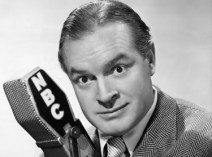 seizing more control over his films, and also squeeze more money out of the studios. Driven by his insatiable dealmaking, by the early 80s, Hope was widely reported to be the richest entertainer in Hollywood, with a net worth estimated as high as $200 million. For all that, he was also intractably cheap. Writers summoned to his home for Sunday morning show conferences were routinely told to “bring your own orange juice.”
At his best, Hope was very funny, his timing and delivery unbeatable. I remember my mother laughing helplessly at Hope’s introduction to the 1968 Oscars: “Welcome to the Academy Awards. Or as it’s known in my house, Passover.” And his comic turns in his best movies, such as some of his “Road” movies with Bing Crosby, are light and deft and have lost none of their power to amuse even 70 years after they were filmed. But for all that, Hope’s humor is curiously impersonal and detached. The audience never gets a glimpse of the guy behind the avalanche of wisecracks; in all of his movie work, there is little that is personally revealing, nothing that comes close to, say, “Annie Hall.”
One’s left with the strong impression that there really wasn’t much to know. Focused exclusively on his work, Hope never read books. As a result of his decades of incessant touring and performing, The Guiness Book of Records called him the human being seen by more people in history, but Hope himself was a semi-stranger to his own family, popping in between months-long tours. He was also an Olympic-class philanderer and skirt chaser, his countless and flagrant extra-marital romps winked in industry circles and ignored by the era’s more protective press. (This last bit is the only bit of Hollywood gossip I can personally attest to. Dining with friends at a Pasadena restaurant in 1988, we saw Hope, then in his mid-80s, at nearby table with a well-turned out blonde woman half his age. He was presenting her with an expensive piece of jewelry and it was clearly a date.)
By its nature, topical humor has a short, short shelf-life — there’s nothing deader than yesterday’s headlines except the jokes that spun off them. That might be one reason why Bob Hope is so little recalled nowadays. Certainly, his refusal to gracefully retire — even in his 90s, as he was clearly failing, he insisted on taking the mic — did nothing to burnish his legacy. But in his prime, he was something, and Hope deserves better.


 Brave New Whirl