But do you trust him?
There’s an interesting summation in The New York Times today of the brouhaha over Amazon.com’s ill-advised kindlelostomy. (Sorry, couldn’t resist.) I won’t replay the whole megillah here, only to say that it seems that Amazon.com decided it possessed the rights to sell the e-book of George Orwell’s 1984 (one of my favorite novels, by the way); then decided it didn’t; and to make everything all better somebody at Amazon decided that the smartest thing to do would be to unilaterally and remotely erase all of the offending, illicit 1984 copies from the Kindles of everyone who had shelled out $9.99 for one.
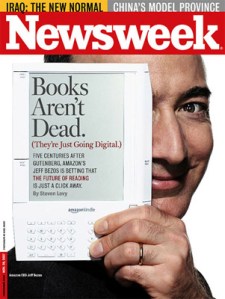
Jeff Bezos has already apologized to the wronged Kindleteers and admitted that Amazon’s solution was “stupid.” But the episode highlights ones one of the defining characteristics of digital content (how I hate that word, but we’ll let that pass for now).
Old Media, whatever its flaws and drawbacks, is immutable. When you buy a dead-trees book, newspaper, magazine or even a (dead-plastic?) DVD, you get to keep it. It’s yours. Forever. The yellowed, much-thumbed paperback of 1984 that lingers on my bookshelf will always read, line by line, exactly the same way. (As a fan of all things Orwell, I say thank God for that.) Short of breaking into my home, no miscreant can take it away. That’s why it’s called a hard copy.
Digital media, on the other hand, not so much. It’s much more than soft—it’s as stretchable, twistable, and mutable as Silly Putty. That’s a great part of its appeal. Nothing is set in stone. In fact, there’s no stone.
I can confidently predict that we’ll see more episodes like Kindlegate in the future, whether at the hands of big e-tailers needing to move more inventory, or rogue hackers looking to cause a bit of mischief, Digital Rights Management or no. For if we’ve learned anything since the dawn of the Internet Era it is that any digital device can be—and eventually will be—hacked by someone determined enough to do so.
As publishers migrate to e-books exclusively, what’s to prevent some ticked-off hacker from erasing entire libraries, whether personal or institutional, with a few deft clicks of his mouse? Just to prove they can. Or a digital publisher from forcing the owners of a certain e-book to replace their old, worn copies with a newer, authorized version of the same title? (Not so outlandish a scenario, if you’ve been following Scribner’s decision to reissue Hemingway’s A Moveable Feast in a new edition that portrays Papa’s second wife more sympathetically.)
Other, more sinister possibilities loom. What’s to stop some interested party from hacking in to an e-book so as to change the work’s ultimate meaning and significance altogether? This is not as far-fetched as it first sounds: Entries in open-source encyclopedias like Wikipedia are frequently edited and redacted by those sharpening their personal ideological hatchets to reflect the facts as they see them.
Might someone tweak Uncle Tom’s Cabin just enough to portray slavery as a beneficent-but-misunderstood institution? And Simon Legree as a struggling, well-intended entrepreneur, desperate to provide needed jobs to his beloved community, but forced to contend with unreasonable, unmanageable employees.
That would be the David Duke edition.
Or maybe make sufficient changes to 1984 to flip Orwell’s distopian satire of Stalinism on its back and transform it into a parable emphasizing the need for a resolute, unflinching, do-whatever-it-takes chief executive to rule a country at war.
That would the Dick Cheney edition, soon to be sold from an undisclosed location.
Update 6/6/2012: In the couple of years since I wrote this piece, I’ve wondered whether I was being over-the-top in my fears that publishers wouldn’t be able to resist monkeying with digital books to suit their own ends. Today I read that a new digital edition of “War and Peace” available for Barnes and Noble’s e-reader substitutes “Nook” for “kindle” (as in “to kindle a fire”) throughout the novel. I wonder what Count Tolstoy would think.


 Brave New Whirl